Reading the Metric Limits and Fits Table
In engineering, a fit refers to the clearance between two mating parts. The choice of an engineering fit determines whether the two parts can move relative to each other in case of a clearance fit, or human action equally a whole in case of a tight interference fit.
While limits and fits apply to all sorts of mating parts, their main utilize is for regulating the sizes of mating shafts and holes for all-time performance.
Both ISO and ANSI have standardised fits in three classes – clearance, transition and interference. Each form has a variety of options available for choosing the right one for a specific awarding.
Tolerance Grade
With engineering fits, the tolerance will always be shown in an blastoff-numeric code. For example, a hole tolerance may exist H7. The majuscule letter signifies that nosotros are dealing with a hole. When indicating tolerance for a shaft, the letter of the alphabet volition exist lowercase.
The number shows the international tolerance form (ISO 286). A tolerance class determines a range of values the last measurement tin vary from the base measurement.
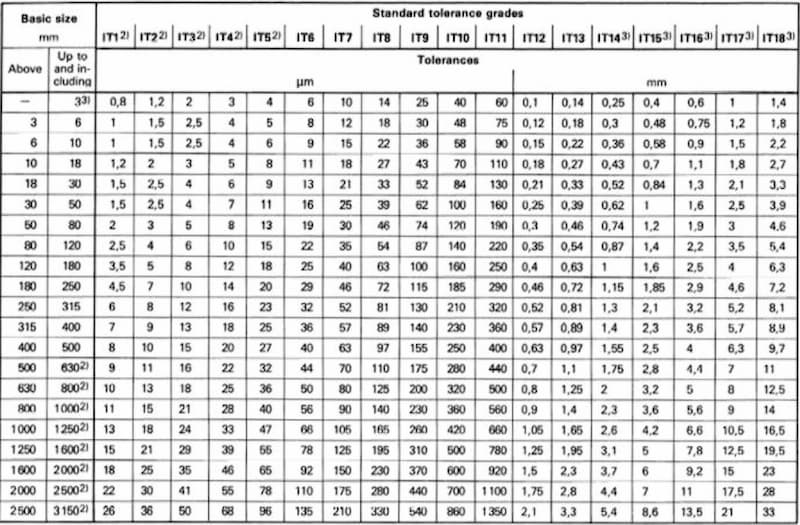
From the table, nosotros can encounter that the tolerance form applies to a range of basic sizes. So if we have a hole with a nominal size of 25 mm and a tolerance class of H7, we will fit into the 18…30 mm bones size group. Looking at the IT7 tolerance grade, the chart gives an allowed variance of 0.021 mm.
The letter of the alphabet signifies the start of the tolerance zone. For H7, the starting indicate is at exactly 25.000 mm. The maximum pigsty size is then 25.021 mm. For F7, the tolerance range is the aforementioned simply the starting indicate is 25.020 mm, taking the last acceptable measurement to 25.041 mm.
A corking mode to notice all the respective technology tolerances to specific measurements is by using a limits & fits calculator.
Hole and Shaft Basis System
When choosing a system for a fit, you have 2 options – hole and shaft system. The organisation tells which part has a controlled measurement and which part is made based on the other.
In short, the hole-ground system uses a constant measurement for the hole and the diameter of the shaft is made accordingly to achieve the required fit.
And the shaft-based arrangement works vice-versa.
Engineers tend to follow the hole system because of simplicity. As the pigsty size stays constant, the shaft's upper and lower deviation values determine the type of fit. Drilling does non allow for much precision, as the tooling comes in sure measurements.
At the same time, CNC turning services are able to create shafts with exact measurements, then achieving the desired fit is just easier this way.
Limits & Fits
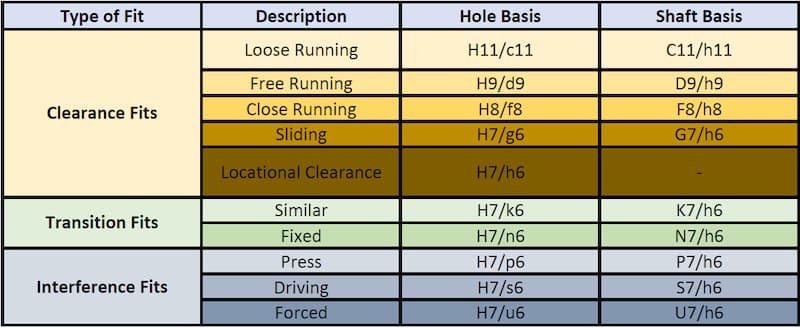
In engineering, we have to define the tolerances of parts to ensure a long lifespan and proper working of a auto. We can choose the fits according to the necessities and working atmospheric condition. The three master categories are:
- Clearance fit
- Transition fit
- Interference fit
All these come with another subset of categories, each designed for different circumstances. Of course, we have to keep in mind that closer tolerances and more than snug fits volition result in college costs considering of higher demands on machining accuracy and the difficulty of associates.
A clearance fit e'er leaves room between the two parts. A transition fit is somewhere in between clearance fits and interference fits and can stop up either style but without leaving much room nor being too tight. A interference fit is tight and creating the fit requires considerable strength and other techniques for easing the process.
Clearance Fits
With a clearance fit, the shaft is always smaller than the hole. This enables easy assembly and leaves room for sliding and rotational motility.
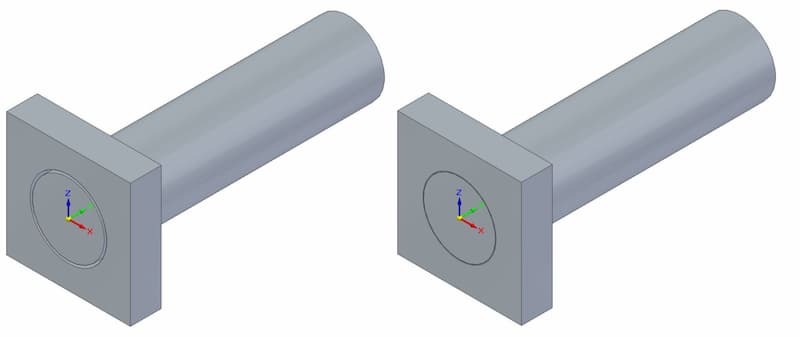
When the shaft diameter is at its minimum and pigsty diameter at its maximum, we have a situation of maximum clearance. When the shaft diameter is at its max and hole diameter at its minimum, we accept a state of affairs of minimum clearance.
Clearance fits come up in six sub-categories. Starting from the loosest:
- Loose running
- Free running
- Close running
- Sliding
- Close clearance
- Locational clearance
Loose Running Fit
Fit with the largest clearance. Suitable for applications where accurateness is not of the utmost importance and contamination may be a problem.
Example uses in engineering: Fits exposed to dust contagion, corrosion, thermal and mechanical deformations. Pivots, latches, etc.
Example fits: H11/c11, H11/a11, H11/d11 (all pigsty-basis), C11/h11, A11/h11, D11/h11 (all shaft-basis)
Using a 25 mm bore, a H11/c11 fit gives a minimum clearance of 0.11 mm and a maximum clearance of 0.37 mm. In this instance, the shaft diameter can fall in between 24.76 and 24.89 mm while the minimum pigsty size is 25 mm and the max 25.xiii mm.
Free Running Fit
Suitable where no special requirements employ to the accuracy of matching parts. Leaves room for movement in environments with heavy temperature fluctuations, loftier running speeds and heavy manifestly begetting pressures.
Example uses in engineering: Applications where maintaining a film of oil lubrication is important. For example, shaft and plain bearing fits with little rotational movement.
Instance fits: H9/d9, H9/c9, H9/d10 (all pigsty-basis), D9/h9, D9/h8, D10/h9 (all shaft-footing)
Using a 25 mm bore, a H9/d9 fit gives a minimum clearance of 0.065 mm and a max clearance of 0.169 mm.
Close Running Fit
Shut-running fits are a skillful choice for applications that crave smaller clearances and moderate accurateness. Good for withstanding medium speeds and pressures.
Example uses in engineering: Machine tools, sliding rods, auto tool spindles, etc.
Example fits: H8/f8, H9/f8, H7/f7 (all hole-footing), F8/h6, F8/h7 (all shaft-basis)
Using a 25 mm diameter, a H8/f7 fit gives a minimum clearance of 0.020 mm and a max clearance of 0.074 mm.
Sliding Fit
Leaves a small clearance for loftier accuracy while maintaining ease of assembly. Parts will turn and slide quite freely.
Case uses in engineering: Guiding of shafts, sliding gears, slide valves, automobile assemblies, clutch discs, parts of machine tools, etc.
Example fits: H7/g6, H8/g7 (all hole-ground), G7/h6 (shaft-ground)
Using a 25 mm diameter, a H7/g6 fit gives a minimum clearance of 0.007 mm and a max clearance of 0.041 mm.
Locational Clearance Fit
Location clearance fits provide minimal clearance for loftier accuracy requirements. The assembly does not need whatsoever force and the mating parts can turn and slide freely with lubrication, helping with assembly by manus. Provides a snug fit for stationary parts.
Example uses in technology: Roller guides, guiding of shafts, etc.
Example fits: H7/h6, H8/h7, H8/h9, H8/h8 (all pigsty-basis)
Using a 25 mm diameter, a H7/h6 fit gives a minimum clearance of 0.000 mm and a max clearance of 0.034 mm.
Transition Fits
A transition fit encompasses ii possibilities. The shaft may exist a little bigger than the hole, requiring some force to create the fit. At the other finish of the spectrum is a clearance fit with a little bit of room for motility.
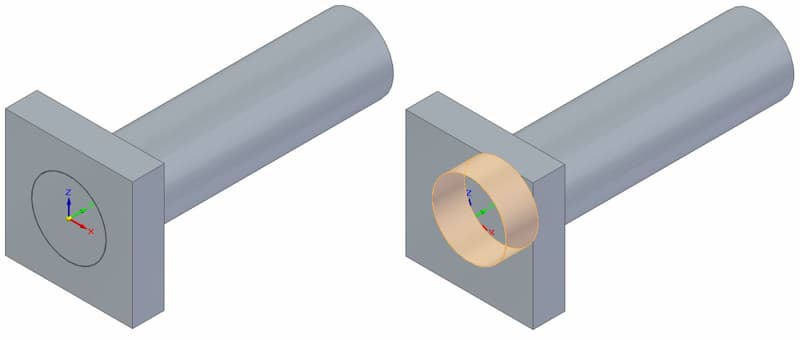
Specifying a transition fit ways that both outcomes are possible even inside a unmarried batch.
Transition fits come in two forms – similar fit and stock-still fit.
Similar Fit
Leaves a small clearance or creates a small interference. Associates is possible using a rubber mallet.
Instance uses: Hubs, gears, pulleys, bearings, etc.
Example fits: H7/k6 for hole-basis and K7/h6 for shaft-basis
Using a 25 mm diameter, a H7/k6 fit gives a max clearance of 0.019 mm and a max interference of 0.015 mm.
Fixed Fit
Leaves a small clearance or creates a small-scale interference. Assembly is possible using calorie-free force.
Example uses in engineering: Driven bushes, armatures on shafts, etc.
Example fits: H7/n6 for pigsty-basis and N7/h6 for shaft-basis
Using a 25 mm diameter, a H7/n6 fit gives a max clearance of 0.006 mm and a max interference of 0.028 mm.
Interference Fits
Interference fits are likewise known equally printing fits or friction fits. These types of fits always accept the same principle of having a larger shaft compared to the hole size.
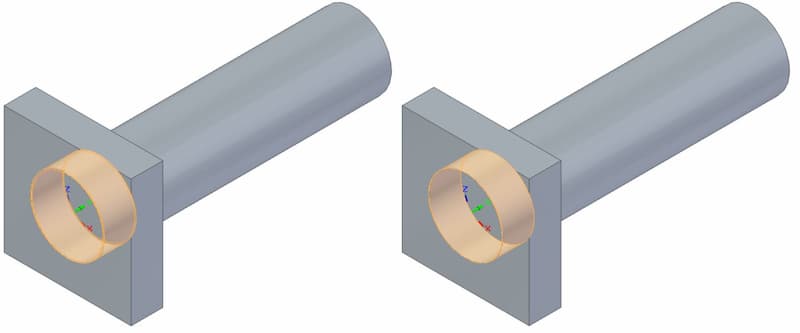
The assembly stage requires force, sometimes lubrication, heating of the hole and freezing of the shaft. These aid to increase/decrease the hole and shaft sizes respectively to make for an easier procedure.
The interference helps to secure the relative positioning of the shaft and hub even during rotation, making this type of fit skillful for transmitting rotational speed and power.
Printing Fit
Minimal interference. Assembly can be performed with common cold pressing.
Example uses in engineering: Hubs, bushings, bearings, etc.
Example fits: H7/p6 for hole-footing, P7/h6 for shaft-footing
Using a 25 mm bore, a H7/p6 fit gives a min interference of 0.001 mm and a max interference of 0.035 mm.
Driving Fit
Needs college assembly forces for cold pressing. Some other style is by using hot pressing. This interference fit is more than prominent than with a press fit.
Case uses in applied science: Permanent mounting of gears, shafts, bushes, etc.
Example fits: H7/s6 for hole-basis, S7/h6 for shaft-footing
Using a 25 mm diameter, a H7/s6 fit gives a min interference of 0.014 mm and a max interference of 0.048 mm.
Forced Fit
Loftier interference fit. Assembly requires heating the office with a hole and freezing of the shaft to force the mating parts together. Disassembly can consequence in broken parts.
Example uses in applied science: Shafts, gears, etc.
Example fits: H7/u6 for hole-basis, U7/h6 for shaft-ground
Using a 25 mm bore, a H7/u6 fit gives a min interference of 0.027 mm and a max interference of 0.061 mm.
webbanctoesend1966.blogspot.com
Source: https://fractory.com/limits-and-fits/
0 Response to "Reading the Metric Limits and Fits Table"
Post a Comment